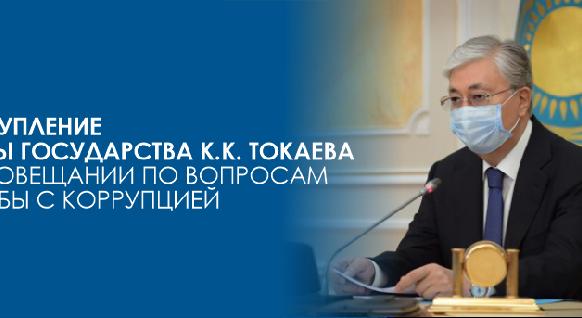
Speech of the Head of State K.K. Tokayev at a meeting on the fight against corruption


Good afternoon, dear colleagues!
Anti-corruption is one of the main priorities of the country's strategic development.
This is my firm position and the promise that I made to people in the electoral program.
In this work, no illusions of "pointing fingers, blindfolded" actions are inadmissible.
The requirements will be strict.
At last year's meeting, we identified a specific action plan.
We have achieved a number of goals today.
Kazakhstan became a member of the authoritative international organization GRECO, a group of states against corruption.
The work of the institute of anti-corruption expertise of normative acts was revived.
The principle of dismissal of subordinates for corruption was introduced.
Well-known international agencies note the measures taken by our country in this direction.
However, we should not be satisfied with what has already been achieved.
The number of corruption cases continues to grow.
Compared to last year, the number of those prosecuted for corruption increased by 11%.
To be honest, we now read in the daily news that officials at various levels are being detained for corruption-related crimes.
Among them there are 2 akims of the region, which in itself is a very alarming symptom.
Corruption eats up the entire vertical of the state apparatus like rust.
According to the results of 7 months of 2020 alone, the number of persons prosecuted for corruption (persons in respect of whom decisions on the qualification of a crime were issued) amounted to 912, which is 11% more than in the same period last year - 820.
We need to further strengthen the fight against corruption during pandemics and a decrease in the income of the state and our citizens.
According to international experts, the risk of misuse and waste is increasing as countries spend more money on pandemics.
The allocated funds must be spent carefully and efficiently. This means that every tenge must be spent for its intended purpose.
Especially in the current situation, we see how society reacts to the waste of money on useless and unnecessary actions.
Therefore, it is very important to pay attention to such issues beforehand and not after the paint has been absorbed.
Loud arrests, spectacular footage have a short-term effect. When such cases later fall apart in court due to lack of evidence, public distrust of the state's measures to combat corruption increases.
Without eliminating the causes and conditions of the corruption phenomena themselves, this is the fight against windmills.
People should see that an official or some leader was not only brought to justice, but also in the work of the state body where they worked, there were corresponding changes for the better, which exclude the repetition of events.
So far, I do not see such comprehensive and preventive work.
Officials change in a circle one after another, and systemic problems are not solved.
We began to check and expose corruption in medicine only after drug shortages in the midst of a pandemic.
We started talking about violations in the digitalization of this sphere only now, when tens of billions of tenge have already been spent.
Now we are allocating huge funds for education, employment and social facilities.
We must have guarantees that in a year we will not again talk about the identified thefts in these areas, that these ministries will not be our anti-leaders.
People don't need pretty reports of detention when billions of dollars have already been stolen
I believe that we must fundamentally restructure this work.
Today the moment has come to unite efforts of the state and citizens. Corruption is a deeply social disease. We can defeat it only by joint efforts.
We need new forms of public control and maximum transparency of management decisions.
For the formation of a "zero tolerance" for corruption in society, purposeful ideological work must be constantly carried out.
In general, anti-corruption activities need to be given a new impetus in all areas.
First. Particular attention should be paid to regular warnings about corruption.
In this regard, it is necessary to conduct a qualitative analysis of the conditions that lead to corruption in various fields.
The law obliges all government agencies to independently identify and fix problems.
However, this work is not being carried out.
Such inaction does not lead to anything good.
If left unmanageable, they can go astray and lose the right path.
Inaction in the fight against corruption leads to the growth of protest moods and legal nihilism among citizens.
It cannot be a coincidence that mass crimes occur, as a rule, in regions with the highest level of corruption.
Today's estimate is based on the number of bribes identified in a given ministry. This also follows from the presented report.
The assessment should be based on the measures taken to prevent, minimize the risks of corruption and remove barriers to the receipt of public services.
The manager should not hide the violations of his employees.
Therefore, it is important not only to punish, but also to motivate. This will greatly facilitate early systematic action.
Each akim and minister should be responsible not only for the money spent, but also for their correct planning. There can be a high risk of corruption here.
Therefore, each leader has an individual responsibility.
I instruct the Prosecutor General's Office to develop such an assessment system.
At the same time, it is necessary to stop unlawful interference in the activities of state bodies.
A clear distinction must be made between corruption and weaknesses in governance.
Honest officials who are not afraid to take responsibility should not be drawn into the orbit of the criminal process. The state apparatus should not be afraid to make decisions.
Today we are witnessing such tendencies when civil servants do not show initiative, dilute responsibility, create unnecessary red tape. This situation was clearly manifested during the pandemic.
An active fight against corruption should not turn into a campaign and a witch-hunt, and should not in any way affect the quality of the work of responsible and law-abiding civil servants.
On my instructions, now the possibility of conviction only on the testimony of accomplices is excluded, criminal liability is introduced for provoking crimes.
These norms will allow to suppress arbitrariness on the part of law enforcement agencies.
I instruct the General Prosecutor's Office and the Anti-Corruption Service to inform me in semi-annual reports about passive leaders who do not have worthy anti-corruption initiatives.
This also applies to local executive bodies.
Second. Fight against internal corruption.
People who face corruption in everyday life are helpless and do not believe in justice.
How profitable was the nationwide pandemic?
For example, employees of the Akimat of the Zhetysu District of Almaty took bribes regularly for citizens to pass through the checkpoint.
Such data was observed in several regions. In fact, I think it happened everywhere.
While our citizens face internal corruption, the work we do with you will be ineffective. It is clear that no international rating is needed.
Giving gifts, demanding gifts, buying diplomas - you don't have to list them.
To do this, we need to achieve a universal aversion to corruption in society.
The anti-corruption agency should work with the government to develop a roadmap to combat internal corruption.
Third. Accelerated digitalization of public services.
Particular attention should be paid to the issue of further database integration.
We still have the practice when, in response to the claims of one department, one has to carry a certificate from another state body.
Digitalization must eliminate such anachronisms.
An interactive map of open budgets has provided public access to information on the spending of more than 7 trillion tenge of budget money (for 2019 - 2020).
"Sergek" showed what benefits the state can bring advanced technologies in terms of fixing violations.
At the same time, he deprived the corrupt income of the dishonest road police officers.
All state bodies, primarily akimats, need to adopt this experience.
These digital solutions eliminate the human factor and eliminate conditions conducive to corruption.
Fourth. Business protection.
Against the backdrop of economic problems, support for entrepreneurship is becoming especially relevant.
Out of 11 persons in cases of raiding - 7 were convicted for five years in criminal cases on obstruction of legal entrepreneurial activity.
These figures show that law enforcement mechanisms to protect businesses are slipping.
Meanwhile, in my Address last year, I said that obstruction of legitimate business is the gravest crime of the state. All law enforcement agencies, including the General Prosecutor's Office, must remember this.
I instruct the Government, together with the General Prosecutor's Office, to submit specific proposals on all the issues raised for approval within a month.
Meanwhile, there are certain positive trends. The institution of anti-corruption support, introduced by us, is bearing the first results.
114 facts of unlawful interference were revealed in 510 business projects in the first half of this year alone.
This work needs to be continued.
The General Prosecutor's Office must immediately suppress the facts of unjustified involvement of entrepreneurs in the orbit of criminal prosecution.
Entrepreneurs and investors need to feel powerful protection against corruption pressures.
Fifth. Strengthening of public scrutiny.
No matter how hard the government agencies try, they cannot achieve success without the support of society.
The ideology of integrity should be formed among our citizens.
Much work is being done in this direction now.
Academic Integrity League, anti-corruption volunteer clubs, integrity kiosks and self-checkouts - information about such projects should be widely publicized.
Strengthening public scrutiny across the entire anti-corruption front must proceed simultaneously.
Civil society is ready to help government agencies.
It was enough to create the Adal Komek platform and more than 11 thousand citizens from socially vulnerable groups received free consultations from well-known lawyers.
By establishing dialogue with citizens, it is possible to identify problem areas where corruption is rife and public outrageous.
People still complain about corruption in universities, colleges and even schools.
Corruption can penetrate our citizens and even become a normal part of society. The main thing is this.
Entrepreneurs believe that the land committee, fire department, tax and customs authorities are corrupt.
The public is also concerned about the quality of the road.
The Anti-Corruption Commission also informed me that there are serious problems in the water sector.
This is where the mechanism of public control over these issues should work.
Non-governmental organizations should be involved in this activity. They should be involved in learning the rules.
An effective fight against corruption and an uncompromising fight against it have become one of the most pressing problems of society for many years.
The security of our country and the well-being of our people depend on systematic and persistent measures in this direction.
I instruct the government to work out the recommendations of the Anti-Corruption Agency within a month, without paperwork and bureaucracy.
As a result, a set of specific measures should be taken. The main goal is to root out corruption.
This work must be done intensively, without delay.
The Presidential Administration must strictly monitor all measures taken and inform me of the results.
Thanks for your attention!
 Related news

Energy University News


