TO RESTORE HISTORICAL JUSTICE


Every year, May 31 in Kazakhstan is celebrated as the Day of Remembrance of the Victims of Political Repression and Famine.
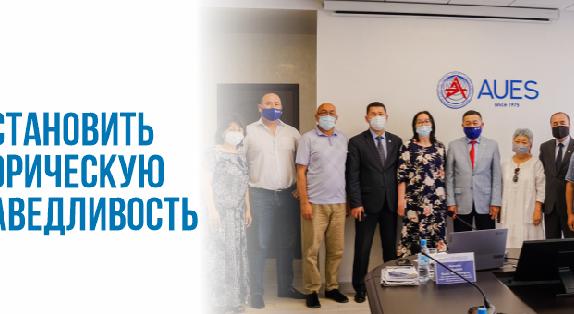
The scientific study of the periods of the Holodomor in Kazakhstan, the identification of its victims is a task of paramount importance. Almaty University of Power Engineering and Telecommunications named after Gumarbek Daukeyev marked the Day of Remembrance of Victims of Political Repression and Famine by holding the International Scientific and Practical Conference "Hunger in Kazakhstan: New Sources and Interpretations". The initiator and organizer of the event was the Department “Social Disciplines” of the AUPET named after Gumarbek Daukeyev.
The purpose of the conference is to discuss topical issues of studying the theme of the Holodomor that took place in the Soviet period in the history of Kazakhstan. Scientists, researchers, faculty of universities, undergraduates and students of Master’s and PhD programs were invited to participate in the conference.
The main directions of the conference: controversial issues in the interpretation of hunger in Kazakhstan: modern research and views, new directions, as well as the source study base of the study of the problem of hunger.
Sagintayeva Saule Savetovna, the Rector of the Non-profit JSC “Almaty University of Power Engineering and Telecommunications named after Gumarbek Daukeyev”, Candidate of Physical and Mathematical Sciences, Doctor of Economics, Professor, Academician of the International Academy of Informatization, addressed the participants with a welcoming speech. Then Makhmutov Serik Kapanovich, Vice-Rector for Educational Work of the Almaty University of Power Engineering and Telecommunications named after Gumarbek Daukeyev, Candidate of Historical Sciences, Associate Professor, spoke. It was noted that this event is a significant step in the development of historical science, promotes the exchange of views between young and experienced scientists from different regions of the country and neighboring countries, maintains a connection between science and practice.
Prominent Kazakhstani and foreign scientists and historians took part in the conference: Ziyabek Yermukhanuly Zabyldinov, Doctor of Historical Sciences, Professor, Director of the Institute of History and Ethnology named after Ch.Ch. Valikhanov of the Ministry of Education and Science of the Republic of Kazakhstan, Corresponding Member of the National Academy of Sciences of the Republic of Kazakhstan; Asankanov Abylabek Asankanovich, Doctor of Historical Sciences, Professor, Director of the Institute of History, Archeology and Ethnology named after Bigamaly Dzhamgerchinov, Corresponding Member of the National Academy of Sciences of the Republic of Kyrgyzstan; Abzhanov Khankeldy Makhmutuly, Chairman of the Republican Historical Society "Adilet", Doctor of Historical Sciences, Professor of the Kazakh National Agrarian Research University, Academician of the National Academy of Sciences of the Republic of Kazakhstan; Aldazhumanov Kaidar Seysembayuly, candidate of historical sciences, professor, leading researcher at the Institute of Ethnology and History Ch. Ch. Valikhanov of the Ministry of Education and Science of the Republic of Kazakhstan; Abdihuakap Kara, Doctor of Historical Sciences, Professor of the University of Art Culture Mimar Sinan (Turkey), Director of the EURASKA Research Center; Elubaev Smagul Abatuly, writer, professor at the T. Zhurgenov Academy of Arts, Honored Worker of Kazakhstan; Shildebay Sabit Kamytbekuly, candidate of historical sciences, director of the Central State Archive of the Republic of Kazakhstan; Mehmet Volkan Kashykchy, PhD, State University of Arizona (USA); Saparaliev Doolotbek Bekishovich, Candidate of Historical Sciences, Professor, Head of the Department of "History of Kyrgyzstan and the Foreign East" of the Bishkek State University named after K. Karasaev, Honored Worker of Education of the Kyrgyz Republic; Semenova Lyudmila Nikolaevna, Doctor of Historical Sciences, Professor of the Belarusian National Technical University, (Minsk); Ametov Temirbek Almasbaevich, PhD in Historical Sciences, Associate Professor, Nukus State Pedagogical Institute named after Azhiniyaz, Republic of Uzbekistan. (Nukus); Orazov Rashid Yessenovich, member of the working group of the City Commission for the complete rehabilitation of victims of political repression, senior researcher at the Institute of History and Ethnology named after Ch.Ch. Valikhanov of the Ministry of Education and Science of the Republic of Kazakhstan.
During the conference, very actual problems and topics were raised and discussed: “Arrival of Kazakhs to Kyrgyzstan during the period of collectivization”; "Kazakstan tarikhy" koptomdylygynyn methodologies are installed "; “Kazakhtandagy ashtyk: zhana derekter men ustymdar”; "Asharshylyktyk kazaktyk san gasyrlyk koshpendi madenietine keri saldary"; “Uly Daladagy uly apat”; "1921-22. Қazaқstandagy ashtyk to his wife ogan қarsy kures tarikhynan "; “New Perspectives on the Kazakh famine: What Can We Learn from Famine Testimonies?”; “Historical information about the contribution of the Kyrgyz people to the rescue of the starving Kazakhstanis in 1921-1933”; "Conceptual approaches to the problem of hunger in the USSR"; "Agrarian policy in the period of low water and drought in Karakalpakstan"; "Halyk commissariats of Kuzhattaryndagy 1931-1933 ashtyk kasireti".
In general, the conference participants noted that the Day of Remembrance of Victims of Political Repression and Famine in Kazakhstan helps to once again remember the past of the Kazakh people, honor the memory of the victims and value their independence. We all must clearly understand the origins and causes of the tragedy that our people experienced in the 20th century. Evolutionary development was interrupted, the traditional way of life was destroyed, and the subsequent accelerated collectivization of agriculture, carried out by the Soviet regime, was accompanied by hunger and direct violence. As a result, our people have suffered such demographic losses that have rarely occurred in world history.
The conference is an important and significant event in the scientific and practical sphere and will contribute to the improvement of the process of scientific research of the indicated topic, create incentives for further fruitful work.
In 1929-33, about two million people died and another one million were forced to leave the country. On the territory of Kazakhstan, 11 camps were created, where the repressed and their family members were in cruel conditions. Not only Kazakhs were subjected to repressions, but also 1.5 million representatives of other ethnic groups who were forcibly deported to Kazakhstan. Compassion and help from the Kazakh people helped them survive and find hope. Repressions were also carried out on a social basis: against former policemen, gendarmes, officials of the tsarist government, priests and entrepreneurs. Political repression became widespread with the onset of forced collectivization of agriculture and accelerated industrialization in the late 1920s and early 1930s. The main reason for the indignation among the people and among the national intelligentsia, which resulted in massive repressions of the Kazakhs by the new government, is considered by many historians to be the Holodomor. Moreover, its first "stage" fell on 1919-1922, the exact number of deaths as a result of which is unknown. As the editor-in-chief of the literary magazine Prostor Valery Mikhailov wrote: “The first famine was also terrible. It touched more on the southern region, although all residents of Kazakhstan suffered to some extent. If in the 30s, according to various estimates, from 1.5 to 2 million people died, then in the first famine - about one million people. World history knows no tragedy of this magnitude. And every Kazakh simply must know, remember this tragedy."
In steppe Kazakhstan, the cause of the famine was also violent measures that forced the nomads to abandon the traditional method of economy - cattle breeding. The surplus appropriation was part of a set of measures known as the "war communism" policy. During the procurement campaign of 1919-20, surplus appropriation also extended to potatoes, meat, and by the end of 1920 to all agricultural products. In the early years of Soviet power, the agrarian, nomadic country underwent significant transformations. Mass industrialization and the growth of cities led to the depletion of the material resources of the peasants.
The Kazakh Holodomor was called asharshylyk.
The second Holodomor in the history of Kazakhstan is also called "Goloshchekinsky". The leader of the Communist Party of Kazakhstan Philip Goloshchekin in 1927 announced the course of "Small October". This meant collectivization and the transfer of Kazakh nomads to a sedentary lifestyle. As a result of these measures, people were deprived of their livestock, property and, under police escort, were sent to the “settling points”. By 1933, about one tenth of the 40 million head of livestock remained.
During the mass famine of 1932-1933 in Kazakhstan, more than one and a half million people died. More than 600 thousand Kazakhs left the country. The policy of the authorities provoked armed uprisings, which were suppressed. 48% of the indigenous population died or left the Kazakh ASSR. Some of the Kazakhs were forced to migrate to Kyrgyzstan, China, Mongolia, Iran and Afghanistan. Violent measures to transfer nomads to a sedentary lifestyle led to huge casualties, mainly among the indigenous population. For the "vacated" places in the period 1938-44 exiled and deported peoples: Ingush, Chechens, Crimean Tatars, Koreans, Balkars, Kurds, Turks, Karachais, Germans resettled. Also, the population of Kazakhstan was replenished with prisoners of the Main Directorate of camps, labor settlements and places of detention: the Karaganda forced labor camp, the Akmola camp for the wives of traitors to the Motherland, etc., some of whom later remained to live in Kazakhstan.
From the very beginning, the national intelligentsia criticized party leaders for "mistakes and excesses" that led to events so tragic for entire peoples. The Soviet government took into account the fact of the participation of many figures in the Alash-Orda movement, which advocated national independence during the years of the civil war. In 1928, 44 "bourgeois nationalists" were arrested. Among those convicted were leaders of the country's national opposition who opposed Soviet policies. Almost all of them were repressed in 1937-1938. It was an attempt to eliminate patriots and intellectuals among the people and thus strike a blow at the national consciousness and unity of the people. Only by 1970 did the Kazakhs regain their numbers at the 1926 level.
According to the President of the Republic of Kazakhstan Kassym-Zhomart Tokayev, “the political repressions of the 20-50s of the XX century are a sad page in the history of our people. To complete the work on the restoration of historical justice, I instructed to create a state commission for the rehabilitation of victims of political repression”. On November 24, 2020, Head of State Kassym-Jomart Tokayev signed a decree "On the State Commission for the Full Rehabilitation of Victims of Political Repression". On December 3, 2020, the first meeting of the State Commission for the Full Rehabilitation of Victims of Political Repression, chaired by the State Secretary of the Republic of Kazakhstan Krymbek Kusherbayev, was held.
The main task of the State Commission is to restore historical justice for all categories of victims of political repression of the Soviet period. After conducting a comprehensive and comprehensive study of materials based on international approaches and standards, the state plans to carry out full legal, and in relation to certain categories - political rehabilitation of victims of repression. The tasks and main points of organizing the activities of the State Commission, its work plan for 2020-2021, issues of methodological support for the rehabilitation of various categories of victims of repression were considered. Special working groups were created to work out directions for the rehabilitation of various groups of the repressed. The organizational stage of the state commission was completed and the active research work of scientists and experts in various archives of the country was started. To ensure the activities of the state commission, a project office was created. Scientists, researchers and representatives of government agencies were included in its composition. For a comprehensive coverage of all areas of the state commission's activities, working groups were formed. Each group carries out its activities within the framework of thematic plans and a certain methodology in accordance with the categories of victims of repression.
To organize the systematic work of the state commission in all regions of the country, regional commissions for the rehabilitation of victims of political repression were created and are functioning. Deputy akims of the regions head them. Scientists, prominent public figures and representatives of state bodies and organizations are in their composition. All members of the working groups will receive permission to work in closed and special archives. Scientists will be exempted from their main work in universities and research institutes with the preservation of salaries and all social benefits. Also, two new draft law, allowing full rehabilitation of victims of political repression, will be developed in the republic. In addition, the list of persons eligible for rehabilitation will be expanded. At the same time, new mechanisms for the rehabilitation of victims of political repression will be developed. All major issues at the meetings of the state commission on the full rehabilitation of victims of political repression will be resolved. All materials will be classified according to the types of repression and categories of repressed.
The Ministry of Culture and Sports has created a specialized collection of archival materials on political repression on the basis of the National Archives and the Central State Archives. Today in this archive more than 1,000 units of archival files are already stored and this is only a small part of the big work that is beginning. The fund will be replenished with documents declassified within the framework of the activities of the state commission.
Doctor of Political Science,
Professor of the Department “Social Sciences” of
AUPET named after Gumarbek Daukeyev
Mukhambedyarova A.T.
 Related news

Energy University News


