Kazakh power engineers held debates at AUPET
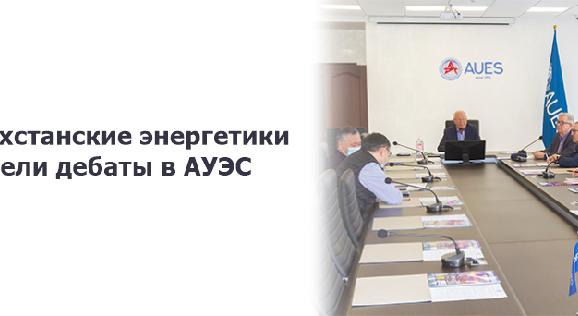


On February 16, 2022, at the Almaty University of Power Engineering and Telecommunications named after Gumarbek Daukeyev, a seminar-meeting was held jointly with the Union of Energy Engineers of the Republic of Kazakhstan. The theme was “Necessity and opportunities for the construction of nuclear power plants in Kazakhstan. Increasing the stability of the energy system of the Central Asian region”.
At the beginning of the event, an intellectual debate arose around the root causes of the instability and accident in the Central Asian Power System (CAPS) in January 2022. But the speakers were unanimous in their opinion that this accident revealed a serious problem in the shortage of capacities in the southern regions of Kazakhstan in 2000 MW. During the discussions, Professor German Trofimov raised the issue of the need to modernize and restructure the architecture of emergency automation systems. And the general director of the Union of Energy Engineers of the Republic of Kazakhstan, Marat Dulkairov, pointed to problems in unloading the North-South electricity transit.
Concrete clarity around the causes of the accident in the Unified Energy System of Central Asia was made by Almaz Saukhimov, Vice-Rector for Scientific and Innovation Activities of AUPET, and Yevgeny Didorenko, Chief Dispatcher of KEGOC.
- On January 25, there was a power surge of 2100 MW, which led to a violation of dynamic stability in the North-East-South transit, - Didorenko said. - Due to the accident at the Syrdarya Thermal Power Plant, the energy system of Uzbekistan was divided into two parts. The western part of the power system of this country was allocated for isolated operation with an increase in frequency to 50.7 Hz. The central part of the energy system remained in parallel operation with the UES with a deficit of 2100 MW. In Kazakhstan, the emergency response system responded, thanks to which we partially saved electricity.
Almaz Sauhimov, Vice-Rector for Science and Innovation, noted that the simulation of this accident made it possible to speed up the course of the official investigation.
- According to the Emergency Disturbance Investigation Act, the following main events were identified: 1) Emergency shutdown of the 500 kV busbar section with generators carrying about 2000 MW at the time of shutdown occurred; 2) Due to the loss of generation, the entire imbalance of the Central Asian system fell on the North-East-South transit; 3) The division of the UES of Kazakhstan on this transit has occurred; 4) Upon the fact of the separation, the teams were sent to work on the Special Automatics for Load Shutdown of the Southern Zone with a volume of 620 MW and OG at the power plants of the Eastern Energy Center, the European Economic Commission, the Krasnoyarsk Hydroelectric Power Plant in the amount of 1150 MW; 5) Due to the decrease in frequency in the systems, the Almaty power center was allocated to isolated work by the action of Intersystem Frequency Dividing Automation, the power plants of the Southern region also went to isolated work by the action of Frequency Dividing Automation; 6) measures to restore the parallel operation of the energy centers allocated for isolated operation were carried out, Saukhimov said.
But after these voiced facts, disputes broke out among some participants of the seminar-meeting, which then resulted in an exchange of professional opinions on the development of nuclear energy in Kazakhstan.
- Today there is no alternative to building a nuclear power plant! I want to explain why this is so. First, today not a single investor will invest in coal-fired generation, since our country joined the Paris climate agreement among 195 countries, - Dulkairov cited his arguments. - Second, even if we find this money, we will not be given the opportunity to obtain equipment. There is no such equipment, except for turbines, since China and some countries have stopped supplying thermal power plants. Even if we build these coal plants even now, in two years we will face a cross-border carbon tax. What it is? All of our export products will be subject to this tax, which will drastically reduce the competitiveness of the Kazakhstani economy. Entire industries will be under attack. We are kicking Kazakhstan out of the competitive environment. This cross-border tax will bind our feet and hands. We need to take into account the current realities. There is no gas in our country - there is no alternative to peaceful atom. The third option is renewable energy sources. For 20 years, we in Kazakhstan have created the best conditions for the development of renewable energy sources. Take and build! What claims? Who is slowing down? But what else can the state do? Having raised any directive document, the rules of technical operation, the rules for the construction of electrical power installations, and in general all the documents, you will read the following there: “ensure a reliable, stable, uninterrupted power supply.” RES - do they provide it? Of course not.
This position caused serious criticism from Professor German Trofimov, who in his speech gave clear facts and proposed solutions to key problems in the development of Kazakhstan's energy sector.
- Marat Turganbekovich, I will speak with pleasure, but I will ask you not to interrupt me, as you did before. I'm not used to it. A moderator is a moderator. And I will only talk about the expediency of a nuclear power plant in Kazakhstan. First, when we talk about nuclear energy, there are many different issues - water supply, use of spent fuel, personnel training, and so on. These are small questions. But there are the main state issues - what? Security issues, social, environmental, political, geopolitical and so on. But I am not an expert in these matters. Therefore, I will not say anything about this. I am an electrical power specialist. And when we talk about the development of a nuclear power plant, we tie it only to the electric power industry. Therefore, from the standpoint of the electric power industry, I will talk about the feasibility of building a nuclear power plant in Kazakhstan. So, today the energy sector of Kazakhstan has two problems. First, the lack of power. Is it all over Kazakhstan? Not! Only in the south there is a shortage of power. Thank you ... Second, the lack of maneuvering capacity. Is the first or the second important? In my opinion, the second question is more important. Why? Because the deficit of the south is a separate issue. And there are many options for solving the deficit of the south, and the issue of flexible capacities today is facing the entire energy sector of Kazakhstan. And if we buy in Russia, then we need to thank Russia, since it gives us peak capacities in exchange for the fact that we return basic capacities to it. Thanks Russia! Thanks! You turned a blind eye to this for 20 years! After all, peak power is 4-5 times more expensive than base power. But I did not come here to sing the anthems of Russia, but I came here to help Kazakhstan. If we supply a nuclear power plant, will we increase the maneuvering capacity or not? Not! This is known throughout the world. From the position of flexible capacities, we will only aggravate the situation in the energy sector of Kazakhstan. I am not against the nuclear power plant and not against all the speeches that were before me, but I want reasoning. That's what I'm talking about! So, I continue. Yes, there is a deficit in the south. We will build a nuclear power plant - is it good or bad? Good! The deficit will be smaller. Let's build renewable energy - is it good or bad? Yes, there will be less shortage. Finally, the third option, which I have already hinted at, is the installation of longitudinal compensation. This is an easy thing. Today there are at least 200-300 such installations in the world. Unfortunately, in Russia there is one such installation. If we only install longitudinal compensation, then we can transfer additional power from the north to the south. And now about RES. 50% of what is said here is not true. All traditional power engineers do not understand RES. I myself was the same as you. But I changed my point of view on RES. Today, world experts say that by 2050, 70% of the planet's energy will be based on renewable energy sources. This is being said by all the statistical agencies along with the World Energy Congress and the World Bank. I believe them! Do you know why? Because in all countries where RES are deployed, the reliability and stability of electricity has increased. It is most important! Increased! Why? But because RES together with themselves brought their brothers - which ones? These are converters and drives. By 2030, the share of drives in the world should increase 126 times. Can you imagine the pace? 126 times in ten years! Why? By the stupidity of the world? Not! It's just that the world's power engineers have understood what RES and storage are, and the Kazakhstani power engineers live in the last century. This is understandable why: today the share of renewable energy in Kazakhstan is 3%. And you want them to provide you with the same thing as traditional energy at 3%. You are deeply mistaken. I respect you, but you are behind. You don't feel what the world feels today. The world today looks at it differently because the share of renewable energy there is high - 30-40%. And when the share of renewable energy in Kazakhstan grows to such a level, the situation will be reborn.
Holding the seminar-conference in such a constructive format contributed to a productive search for solutions to acute problems in the Kazakh energy sector. The points of view expressed speak of the high intellectual level of the entire professional community of power engineers in Kazakhstan.


 Related news

Energy University News


