From the Russian laser to hypersonic weapons. Review of the Russian journal “Trends. Developments. Markets”
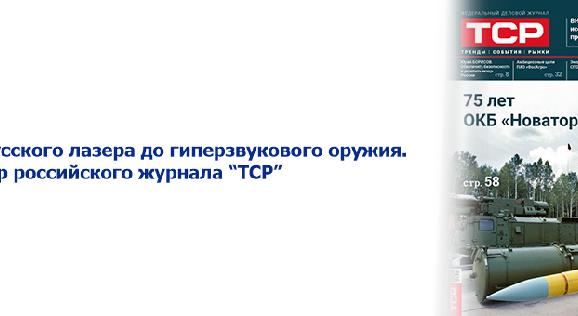


The review of the Russian federal business journal “Trends. Developments. Markets” (January-February 2022) is useful for a deep understanding of the unique scientific and technological breakthrough in neighboring Russia, which is taking place in the context of the armed conflict in Ukraine, international sanctions and a complete break with the intellectual circles of the West. A market economy was established in this country, but socialist elements remained in the management of military-political and economic projects. Such a Third Way is forced due to severe geopolitical pressure from NATO, Turkey, Iran, Pakistan, China and Japan along the entire perimeter of Russian borders. Therefore, we need to objectively look at the processes that are taking place in Russia, and adopt the most advanced and unique that this country has for the development of our native Kazakhstan.
A little about the journal
Federal business jounal “Trends. Developments. Markets” is a monthly business publication that introduces the development of Russian regions, advanced ideas and technologies, the activities of leading companies, and business leaders. For 12 years of successful work, a certain circle of readers loyal to the publication, regularly turning to the journal as a source of information and a channel for promoting the company, has developed.
The target audience is the heads of Russian companies (engineering, metallurgy, oil and gas industry, electric power industry, road industry, transport, chemistry, petrochemistry, construction, communications, banking, insurance, financial sectors) and government agencies.
The journal has been published since 2006. The circulation is 5000 copies. A4 format, full color.
The January and February issue of the journal “Trends. Developments. Markets” was presented at the following venues and exhibitions:
1) International Congress and Exhibition Hydropower: Central Asia and the Caspian (February 16-17, Dushanbe, Tajikistan);
2) International conference Arctic-2022 (March 2-3, Moscow, Russia);
3) International Conference Mining Industry of Russia and the CIS (March 23-25, Murmansk, Russia);
4) Downstream Russia Conference (oil and gas processing, petrochemicals) (March 2–3, Krasnodar, Russia);
5) Planned. International exhibition of advanced technologies for ensuring the security of the individual, society and state EXPOTECHNOSTRAZH (March 16-18, St. Petersburg, Russia).
Congratulations to the Rector of MPEI
In the journal "Trends. Developments. Markets” a large article about the Almaty University of Power Engineering and Telecommunications named after Gumarbek Daukeyev was published as part of the celebration of the 60th anniversary of the rector of the NRU “MPEI” N. D. Rogalev.
“The faculty of the Almaty University of Power Engineering and Telecommunications named after Gumarbek Daukeyev, represented by Rector Saule Savetovna SAGINTAYEVA, as well as the student youth of the university, congratulate the Rector of the Moscow Energy Institute Nikolai Dmitrievich ROGALEV on a significant 60th anniversary. We thank you for the fruitful cooperation. We wish you many more years of productive activity in the scientific field, success in solving strategic tasks related to the introduction of innovations and digitalization of the economy, health and well-being!” The Rector Saule Sagintaeva congratulated on the pages of the journal.
A whole spread tells about the achievements and successes of the university. “Over the past ten years, AUPET has achieved significant changes aimed at transforming into a research university. AUPET has proved by its activities that it has great potential to create a center of competence in the field of energy, communications, automation of production and digitalization of business processes,” the article notes.
Russia strives for a "clean" energy balance
In Russia, parallel to the peaceful atom, green energy is developing. And in general, Russians try to avoid politicizing the energy industry, as they understand that this harms the development of the economy.
The article “The Gaidar Forum 2022: Initiatives for the Socio-Economic Development of the Russian Federation until 2030” states that Russia’s energy balance is dominated by gas (45%). And in the world hydrogen market, this country could take about 20%. In addition, it is written that the task was set to reach the volume of two million tons of hydrogen export by 2030.
The article also contains information that Russia has adopted a program to support renewable energy sources (RES) until 2035. In 2022, the share of renewable energy in this country is about 1%, but the government has plans to develop this area and reach 12% by 2050, and it is also planned to increase the share of nuclear energy to 25%.
The note on page 26 says that on January 25, 2022, in Petrozavodsk, the Minister of Energy of the Russian Federation Nikolai Shulginov launched the work of the new 330 kV Kola-Karelian transit. It ensures the energy security of the three regions of the North-West. The new energy transit is about 3.5 thousand new poles, 1.1 thousand kilometers of Electric Transmission Lines, six power centers, including the newly built 330 kV Kamenny Bor and Borey distribution points. Four more substations in the territory of the Murmansk region, Karelia and the Leningrad region were reconstructed. Increasing the transmission capacity of the network will increase the output of the Kola NPP, the Serebryansky HPP cascade, ensure the power output of the Kola wind farm under construction and, in turn, cover the needs of the energy system of the Republic of Karelia and increase the reliability of power supply to consumers in the region.
The article “The 85th Anniversary of Orenburg Oil: Successes of the Region and Orenburg Neft” says that in 2021, thanks to the Orenburg Neft energy saving program, more than 21 million kWh of electricity were saved. This program included 1,300 events aimed at optimizing operating modes and introducing energy-efficient equipment in the mechanized well stock and at surface infrastructure facilities.
In the article "Gazprom. Underground gas storage system”. For the Energy Security of the State” it is written that an underground gas storage system has been created and deployed in Russia. During the heating period, this network provides about 20% of gas supplies to Russian consumers and for export, and on cold days this value can reach up to 40%. 23 storages created in 28 geological structures are in operation. The total volume of the operational reserve of underground gas storage facilities today is more than 72 billion cubic meters. The value of the maximum daily productivity is more than 800 million cubic meters. These figures are growing every year. In the winter period of 2019-2020, Gazprom increased the gas reserve in the Underground Gas Storage System to a record amount of 72.2 billion cubic meters (!).
Arctic energy
The article "Energy of the Arktika" contains information about the activities of the Northern Production Association "Arktika", which is the largest enterprise in the north of Russia and the flagship of the ship's electrical installation industry. The management of this enterprise set the task of creating the Center for Industrial Specialization "OSK-Electrical Works". The center involves the creation of a network of compact and efficient production branches. The main goal is to provide high-quality services in the field of electrical installation work and complex deliveries of electrical products.
In order to attract personnel, NPA “Arktika” cooperates in Severodvinsk with Sevmashvtuz (Institute of Shipbuilding and Marine Arctic Technology), which implements a training program according to the “plant-higher technical educational institution” system, as well as the Technical College of the Northern (Arctic) Federal University named after M.I. V. Lomonosov and the Severodvinsk College of Electrical Installation and Communications.
The article "Increasing the competitiveness of ship equipment" says that today in Russia a transition is required from traditional methods of installing ship equipment to modular-aggregate methods, which allow increasing the technical and economic indicators of production and its competitiveness. These principles of shipbuilding determine the need for unification of assembly units of ship equipment with bringing them to a modular design. To realize this, the integration of multifunctional cable systems is carried out based on the use of combined cables produced by JSC Special Design Bureau of the Cable Industry and hybrid assemblies based on combined connectors. Combined cables are considered as systems designed not only to transmit electrical signals of various frequencies, but also to provide information to the life support systems of ships and vessels, as well as to perform auxiliary functions of lighting, indication and monitoring of environmental parameters based on fiber optic modules, which makes it possible to implement a qualitatively new the level of increasing the reliability of cable ship systems through the creation of components of automated control systems (smartgrid).
Russian path in the development of artificial intelligence
Russia is far behind the NATO countries, China and Japan in the field of artificial intelligence. International sanctions, distrust of foreign software, and a lack of competent specialists due to a break with Western intellectual circles are objective reasons why Russians have to reinvent the wheel. This slows down the development of Russian aviation and drones. Thus, in the article “Intellectual Sovereignty” it is written that Russian research in the field of AI technologies covers two main areas: 1) Intellectualization of aircraft functional software; 2) Development of domestic software platforms for the development of AI applications.
What does this really mean? New electronic filling is being introduced into old models of technology, qualitatively improving their characteristics, and also including them in a single intellectual ecosystem. Deep modernization.
Other interesting information is available in the article “JSC ENIKS: UAVs for military and civil purposes”, which says that in the Republic of Tatarstan the Center for Aircraft Modeling and Training of Remote Pilots of UAVs of ENIKS JSC was opened to train specialists for the army and the civil sector.
The Center has classrooms, a control room, a fleet of vehicles, hangars, garages and a whole range for practical training. 12 people can train at the training ground at the same time. Students have the opportunity to take both basic and advanced courses. Upon completion of training, each graduate receives a UAV ground control operator certificate and / or an UAV ground launch operator certificate.
In general, for a clearer understanding of the Russian movement in the intellectualization and modernization of technology, it is worth reading an interview with Sergei Aksenov, Advisor to the Head of the Research Department for the Development of Rocket and Artillery Weapons of the JSC “TsNIITOCHMASH” - “Brains for Nona-S” (https://vpk-news.ru/articles/65989). The text talks about the important role of systems engineers (control system architects) and programmers in debugging systems.
What is the uniqueness of the Russian laser?
Russia is the world leader in dual-use laser technologies. Such progress is associated with powerful fundamental science, as well as a high level of technology in the mining industry.
In an interview with the Regional Center for Laser Technologies: At the Start of New Opportunities, the history of the formation of the Russian Regional Center for Laser Technologies, which was created in 1997 on the basis of the Sverdlovsk Research Technological Institute, is briefly told. The Russians repeated the European principle of business organization. Germany was taken as a basis, where a center with high-tech modern laser equipment within a radius of 50 kilometers serves all enterprises and entrepreneurs.
Today, the Regional Center for Laser Technologies provides a full range of services for the development and implementation of laser processing technologies for titanium, aluminum alloys and steels. In addition, in order to develop and create GOSTs for laser technologies in 2017, the Regional Center for Laser Technologies created subcommittee No. 8 "Laser production technologies" as part of the Technical Committee 296 of Rosstandart and issued three standards for heat treatment. Today the center develops and prepares for the approval of GOST for laser cutting.
In 2021, the center received unique equipment - the latest mini laser marker - that allows you to create color images on metal. This is achieved through laser action on the corresponding metal structure and the finest control of the laser radiation power, as a result, different oxides are formed at different temperatures, and they give different colors, especially on titanium.
The success story of the Regional Laser Technology Center demonstrates the relationship between basic science and the mining industry, which is the birth of genuine progress in the development of dual-use laser technology.
Russian hypersonic weapons
In fact, the history of Russian hypersonic weapons dates back to the 70s, when the Ustinov Doctrine was implemented, which was to build up the capabilities of Soviet missile systems to achieve a strategic initiative over the naval component of the NATO bloc. Therefore, in the USSR and in some countries of the Warsaw Pact they abandoned the construction of expensive aircraft carrier strike groups. This decision turned out to be correct many years later, when the new Russia had to concentrate on the development of hypersonic weapons in order to somehow resist NATO and other world navies. The Zircon hypersonic system is a belated fruit of the Ustinov Doctrine.
The article “Military-Industrial Corporation Scientific and Production Association of Mechanical Engineering. In the sea, air, space” says that in 2021 the Ministry of Defense of the Russian Federation signed a contract for the supply of Zircon missiles. In its class, the rocket became the first in the world, able to carry out long aerodynamic flight with maneuvering in dense layers of the atmosphere using its own engine thrust throughout the route.In addition, the rocket is controlled in hypersonic modes; it is possible that a unique electronic filling with AI functions was developed and implemented, which is able to withstand extreme overloads during flight time.
Conclusion
A similar scientific and technological breakthrough can be made by Kazakhstan, since we have had a single way of life for a long time. The Russian language is not only the language of interethnic communication, but also provides an opportunity for the exchange of experience and knowledge with Russian colleagues and partners in the field of science and education. Today, Kazakhstan needs to take advantage of this unique historical chance to become one of the most competitive countries in the world and become a powerful energy and industrial power in Eurasia.
The review was prepared by the press center of AUPET named after Gumarbek Daukeyev
 Related news

Energy University News


