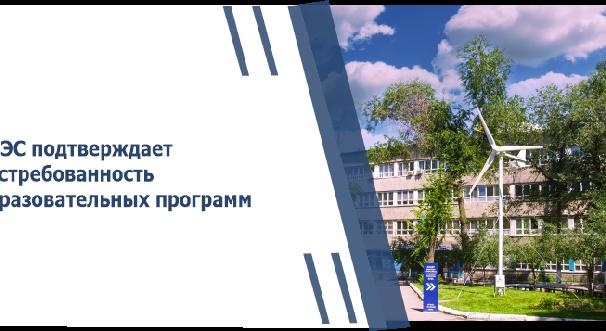
AUPET confirms the demand for educational programs


In the modern field of education, it is necessary to achieve a high result in the training of in-demand personnel focused on changes in the needs of the real labor market. Therefore, the issues of continuous professional development of the faculty, modernization of the laboratory and scientific base of universities need to be addressed focusing on the labor market.
Earlier, the Ministry of Education and Science of the Republic of Kazakhstan changed the requirements for the educational activities of Kazakhstan universities. Innovations were introduced depending on the specialties. They were aimed at strengthening the focus on the practice of higher education. Universities have been able to recruit more specialists - practitioners.
The work of Non-profit JSC "AUPET named after Gumarbek Daukeyev" in the direction of developing educational programs based on professional standards is carried out at a high professional level. Of the 49 universities that provide training in these Groups of Educational Programs, AUPET is in the top three in terms of the number of students admitted. These are the following State Educational Programs: "Electrical Technique and Electrical Engineering", "Communications and Communication Technologies", "Air Transport and Technologies", "Electrical Engineering and Automation", "Sanitary and Preventive Measures", "Information Security".
Over 75,000 grants have been awarded this year. Of these, 15,221 fall into groups of educational programs for which training is being conducted at AUPET. 1495 holders of the state grant, including 55 holders of the “Altyn belgi” sign, chose the Almaty University of Power Engineering and Telecommunications named after Gumarbek Daukeyev. This once again confirms the demand for AUPET educational programs.
The next task in the education system of the Republic of Kazakhstan is the adaptation of the education system to the requirements of employers and the implementation of clear algorithms for the development of educational programs based on professional standards. The main advantage of the new programs is that they are aimed at obtaining practical knowledge that is needed in the labor market. Dual training, when students spend up to 40% of study time at enterprises, is being actively implemented.
New educational programs are also positively assessed by the students themselves. They note that during their development, attention was focused on practical knowledge.
Professor Mukhambedyarova A.T.
 Related news

Energy University News


