UniSat members have launched educational nanosatellite
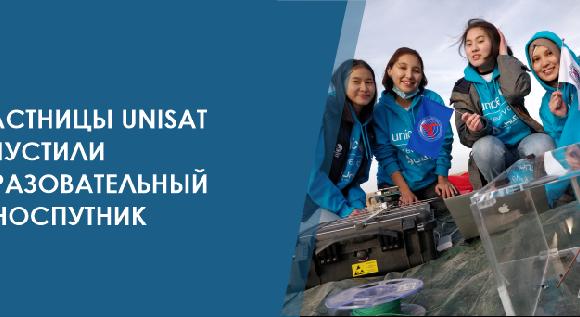


On October 30, 20 girls, members of the UniSat educational program, launched an educational nanosatellite using a helium balloon into the stratosphere. UniSat is the educational program of UNICEF and the Science and Technology Park of the Al-Farabi Kazakh National University.
Today, the international organization UNICEF pays great attention to gender policy among youth and periodically allocates special funding to support STEM education for girls. The UniSat project is the first joint project between the Science and Technology Park and UNICEF to develop an educational course on nanosatellites.
A third-year student of the specialty "Space Engineering and Technology" - Zhalymbetova Inkar was one of the active participants in this large-scale project. For eight months, together with other girls, she studied on courses on creating a nanosatellite at the Al-Farabi Science and Technology Park. During her studies, Inkar gained knowledge of how to design, program, assemble and conduct complex ground tests of a nanosatellite. As Inkar notes, the UniSat project was designed not only to develop skills and competence in the development of nanosatellites, but also to develop flexible skills (Soft Skills) for girls, such as teamwork, public speaking, time management, creativity, etc.
The UniSat satellite is equipped with several cameras and sensors that collect data on radiation, gravity, pressure and gas composition. Large amounts of data, videos and images were sent back to Earth for analysis. As part of the partnership between UNICEF and the Al-Farabi Science and Technology Park, 20 girls were trained by leading experts in the field of space technology and technology. They mastered the basics of modeling a nanosatellite body based on the Invertor Software, designing the main blocks of software control, developing software and hardware, working out radio communications and conducting complex tests based on European standards for creating a nanosatellite like Cubesat.
In the future, UNICEF plans to expand the scale of the project through innovative crowd funding and sponsorship, as well as improving the technologies for creating the satellites themselves.
 Related news

Energy University News


