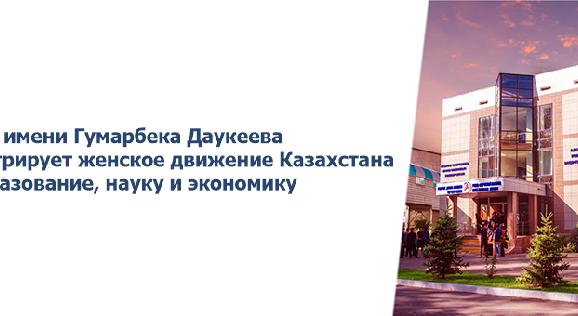
AUPET named after Gumarbek Daukeyev integrates the women movement of Kazakhstan into education, science and economy


If we turn to the issue of gender in Kazakhstan in general, then, unlike many democratic Western countries, women's suffrage in Kazakhstan, as in all post-Soviet countries, has existed since 1917. Our country, as a member of the United Nations, along with the 1979 UN Convention on the Elimination of All Forms of Discrimination Against Women, has ratified other major international acts on women's rights: the 1952 UN Convention on the Political Rights of Women, the 1958 UN Convention "On the Citizenship of a Married Woman", International Labor Organization Convention No. 100 "On Equal Remuneration for Men and Women for Work of Equal Value" and No. 156 "On Equal Treatment and Equal Opportunities for Working Men and Women: Workers with Family Responsibilities" and others. All of them, according to the Constitution of the Republic of Kazakhstan, are included in the legal system of the country and have priority over the norms of national legislation.
Today, the level of social development and gender equality in Kazakhstan is at a fairly high level. This is due to the state policy of modernizing society. Thus, the Constitution of the Republic of Kazakhstan recognizes and guarantees the absence of discrimination, including on the basis of gender.
Kazakhstan has adopted the Concept of Family and Gender Policy in the Republic of Kazakhstan until 2030, aimed at increasing the participation of women in the labor force and in leadership echelons, in vocational training for technical sectors of the economy and preventing discrimination against women employed in non-traditional professions. Thus, the Government of Kazakhstan has taken constructive steps to reduce the list of jobs where the use of women's labor is prohibited, excluding 75 positions in 2018 on the basis that these types of activities no longer harm women's health.
61% of the faculty and staff of the University are women. It is significant that out of 178 teachers of the University with academic degrees and titles, 91 people (or 51%) are representatives of the fair sex. Three out of five Institutes, 8 departments out of 17 are headed by women. And in general, 67% of heads of departments and services are representatives of the “weaker” sex. The increased representation of women in positions reflects their high level of qualification and allows them to be classified as professionals.
Our university is a technical university in Kazakhstan and trains personnel for industry. Girls studying in technical specialties make up about 30%. And it is gratifying to note that there is a trend towards an increase in the number of girls involved in research activities. Among the students in the educational programs of the magistracy, about 40% are girls, and in the educational programs of the doctoral program 50% (32 women versus 31 men). And this indicates that women employed in the engineering and technical sector of the country's economy, on average, have a higher level of education than their male counterparts.
Thus, women play a significant role in the engineering industries. Great opportunities exist for increasing their participation, especially in senior management and in production. Our university creates such opportunities for their professional and career growth in the future. It provides additional educational programs in the following areas: Environmental Engineering, Finance and Marketing in Engineering, Economics and Organization of Fuel and Energy Complex Enterprises, Industrial Safety, IT Technologies, Automation and Business Process Management in Energy and Telecommunications and many others.
 Related news

Energy University News


