A Scientific-Educational Hub for Space Technologies Opened at Energo University
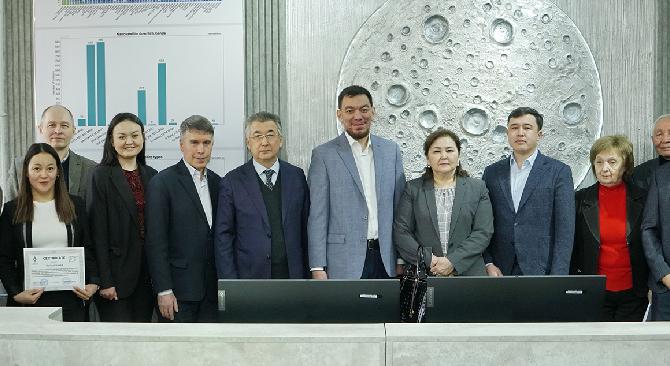


The hub will become a focal point for students eager to explore space technologies.
ALMATY, February 21, 2024 – Today, at Energo University (Almaty University of Power Engineering and Telecommunications named after G. Daukeev), based at the Institute of Communication and Space Engineering, a scientific-educational hub for space technologies was inaugurated. Its primary mission will be to actively attract students to space technologies. At the hub, students have the opportunity to acquire skills in working with digital transceivers, organizing communication with satellites in various orbits, and conducting radio communication with amateur radio enthusiasts from around the world.
Leaders of key Kazakhstani scientific organizations in the field of space, based in the city of Almaty, participated in the opening ceremony of the hub: the Chairman of the National Center for Space Research and Technology M.R. Nurguzhin, Deputy Director for Science of the Ionosphere Institute B.A. Iskakov, Deputy Director for Science of the Astrophysical Institute named after G. Fesenkov R.R., Deputy Director for Science of the Astrophysical Institute named after G. Fesenkov Valiullin R.R., Director of the Institute of Space Technology and Technology R.S. Buralhiev, as well as the management, faculty, and students of Energo University.
Marat Rakhmalievich Nurguzhin, Director of the National Center for Space Research and Technology, Doctor of Technical Sciences, Professor, Academician of the International Academy of Informatization and the Engineering Academy of the Republic of Kazakhstan, noted in his welcoming speech that the opening of this hub at the university is a significant event in the development of Kazakhstan's space activity infrastructure.
The new hub is created on the principle of integrating science and education in the field of space technologies. The Flight Control Center (FCC), implemented on its basis, will allow for the transmission and reception of analog and digital radio signals from various satellites, such as AO-91, AO-92, SO-50, RS-44, FO-29, IO-117, NOAA 15, 18, 19. Furthermore, the equipment at the FCC will enable students to conduct both local UHF radio sessions and global ones with amateur radio enthusiasts from around the world through orbital satellites, as well as through the International Space Station (ISS).
The hub is equipped with computers, software-defined radio system devices (SDR devices), transceivers for the UHF range, antenna systems of two types, and large screens for displaying the trajectory of satellites. With the UHF range transceiver, students will be able to exchange information with nanosatellites. The use of modern digital equipment at the hub, including SDR technologies, will provide flexibility in the educational process. This equipment allows students not only to conduct various laboratory works in the educational process but also to use them as a scientific component for the study of weather satellites, such as NOAA (USA), Meteor (Russia), etc.
The scientific-educational hub with the Flight Control Center will become one of the elements of the space infrastructure not only of Energo University (AUPET named after G. Daukeev) but also of all scientific organizations in Kazakhstan working in the field of space activities.
 Related news

Energy University News


